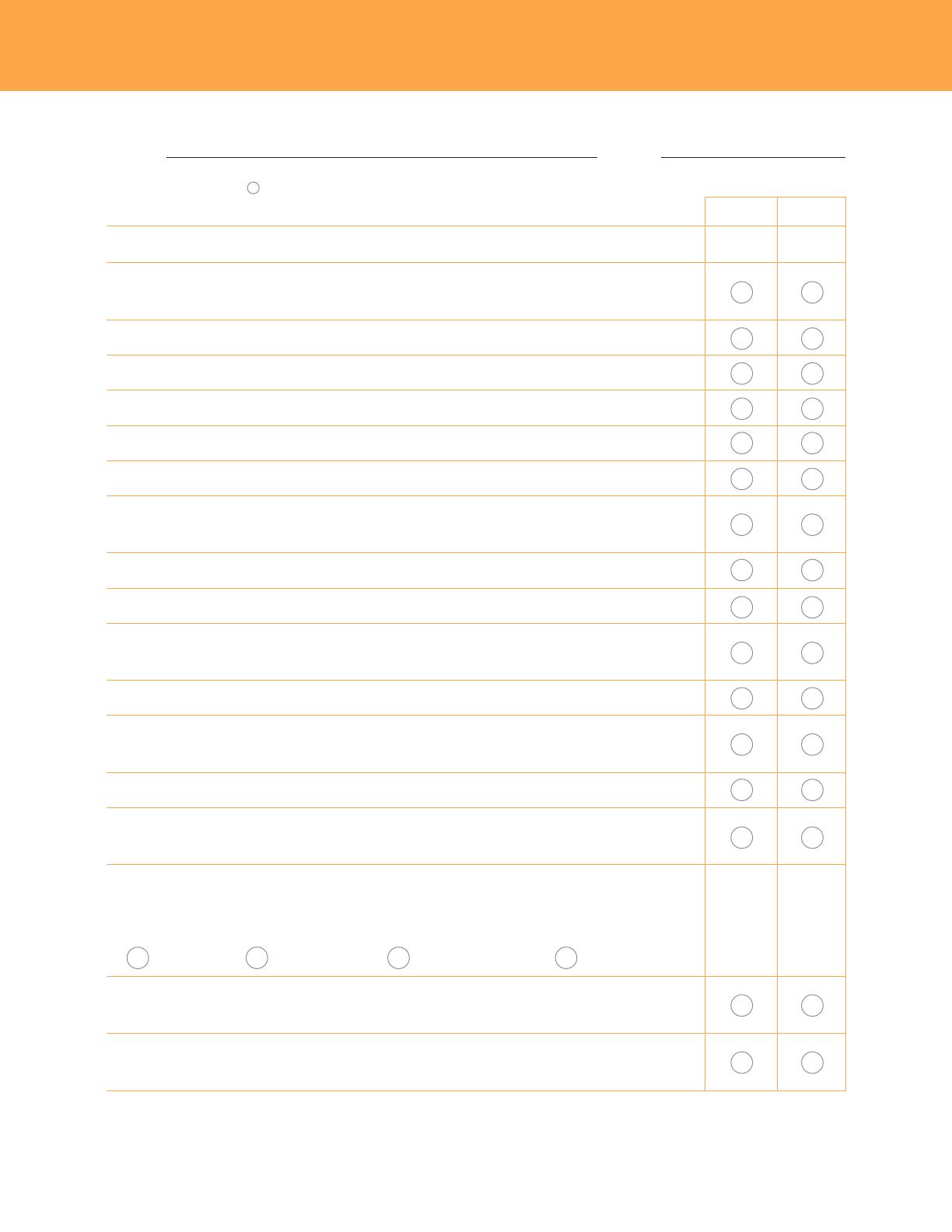
Mood Disorder Questionnaire (MDQ)
Name: Date:
Instructions: Check (
✓
) the answer that best applies to you.
Please answer each question as best you can.
1. Has there ever been a period of time when you were not your usual self and…
…you felt so good or so hyper that other people thought you were not your
normal self or you were so hyper that you got into trouble?
…you were so irritable that you shouted at people or started fights or arguments?
…you felt much more self-confident than usual?
…you got much less sleep than usual and found you didn’t really miss it?
…you were much more talkative or spoke faster than usual?
…thoughts raced through your head or you couldn’t slow your mind down?
…you were so easily distracted by things around you that you had trouble
concentrating or staying on track?
…you had much more energy than usual?
…you were much more active or did many more things than usual?
…you were much more social or outgoing than usual, for example, you
telephoned friends in the middle of the night?
…you were much more interested in sex than usual?
…you did things that were unusual for you or that other people might have
thought were excessive, foolish, or risky?
…spending money got you or your family in trouble?
2. If you checked YES to more than one of the above, have several of these ever
happened during the same period of time?
Please check 1 response only.
3. How much of a problem did any of these cause you — like being able to work;
having f
amil
y, mone
y, or l
egal tr
oubles; getting into arguments or fights?
Please check 1 response only.
No problem Minor problem Moderate problem Serious problem
4. Have any of your blood relatives (ie, children, siblings, parents, grandparents,
aunts, uncles) had manic-depressive illness or bipolar disorder?
5. Has a health professional ever told you that you have manic-depressive illness
or bipolar disorder?
This ques
tionnair
e should be used as a s
t
arting point. It is not a substitute for a full medical evaluation.
Bipolar disorder is a complex illness, and
an accurate, thorough diagnosis can only be made through
a personal evaluation by your doctor.
Adapt
ed fr
om Hir
schf
eld R, Williams J, Spitzer RL, et al. De
v
el
opment and v
alidation of a scr
eening instrument for bipolar spectrum
disor
der: the Mood Disor
der Ques
tionnair
e.
Am J Psychiatry.
2000;157:1873-1875.
Yes No



